Temperature Aerosols huMidity lidAr at Reunion IslaNd
TAMARIN is the first next-generation lidar system developed by the CNRS Lidar Operations Group to meet its commitments to the European research infrastructure ACTRIS. Following validation near Paris, the system will be deployed in autumn 2026 at the Observatoire de Physique de l’Atmosphère de La Réunion (OPAR), located at the Maïdo observatory.
International observation networks such as the European research infrastructure ACTRIS (Aerosols, Clouds and Trace Gases Research Infrastructure) or NDACC (Network for the Detection of Atmospheric Composition Change), recently integrated within ACTRIS, play a central role in the long-term monitoring of atmospheric composition for meteorological and climate studies. Their missions include documenting the evolution of aerosols and key trace species in both the troposphere and stratosphere, with a particular emphasis on climate-relevant components such as water vapor, aerosols and clouds. Monitoring these compartments of the atmosphere is essential, as climate change is uncertain for a large part due to aerosols and clouds and is expected to increase the occurrence of stratospheric clouds, which contribute to ozone depletion via heterogeneous chemistry.
Ground-based lidar systems have long been recognized as essential tools in atmospheric surveys. They complement spaceborne observations and are both vertically and temporally resolved. Several Raman and elastic lidars have demonstrated their ability to deliver long-term data series, such as the ARM Raman lidar or NDACC-certified lidars at sites including Haute-Provence and Mauna Loa. These instruments have established reference measurements for aerosols and water vapor from the boundary layer to the lower stratosphere, and their impact on climate. In contrast, smaller, field-capable Raman lidar systems developed at LSCE for specific field-campaigns highlighted the capability of such instruments to characterize aerosol and moisture variability in harsh environmental conditions. The Institut des Sciences de l’Univers (INSU) of CNRS thus founded the national Lidar operational group to transfer these technological bricks for the renewal and long-term operation of lidar instrumentation at the two main French atmospheric observatories: Observatoire de Haute Provence (OHP) and Observatoire de Physique de l’Atmosphère à la Réunion (OPAR).
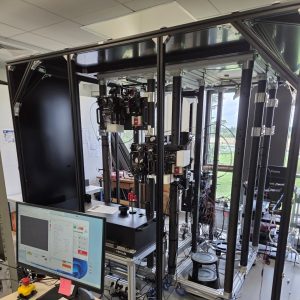
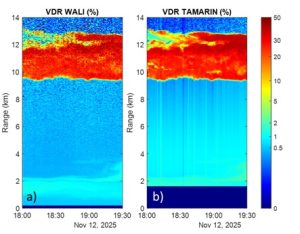
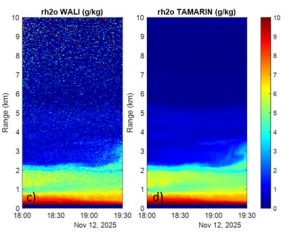
The first qualified signals of the TAMARIN lidar were obtained during nighttime on 12 november 2025 at LSCE, south of Paris, with temporal and vertical resolutions of 10 seconds and 12 m, respectively. The photon count showed the SNR is about 40 at 10 km for the 355 nm channel and 0.55 at 10 km for the 407 nm channel, which translates respectively to 1.4 103 and 56 at the target resolutions. Here after, we show initial inter-comparisons between TAMARIN and WALI (1-minute integration), demonstrating a high level of agreement for both Volume Depolarization Ratio (VDR) and water vapor mixing ratio (WVMR). Structures and amounts are well reproduced, at higher SNR for TAMARIN.